Physical Therapy for Rounded Shoulders in NJ
Clifton Physical Therapy
What Are Rounded Shoulders?
Rounded shoulders occur when the shoulders naturally rest farther forward than they should. While many people assume the problem starts with the spine, it often begins with the position of the shoulder blades (scapulae), which are supported by muscles rather than directly connected to the spine. When these muscles become imbalanced, the shoulder blades shift forward, creating a slouched posture.
This condition has become increasingly common due to today's lifestyle. Hours spent working at a computer, looking down at smartphones, driving, or sitting for prolonged periods place continuous stress on the neck, shoulders, and upper back. Over time, these repetitive positions train your body to accept poor posture as normal.
Rounded shoulders are more than a cosmetic concern. They can affect the way your muscles work, reduce shoulder mobility, increase strain on the neck, and contribute to ongoing discomfort during everyday activities.
What Causes Rounded Shoulders?
Rounded shoulders rarely develop from a single cause. Instead, they usually result from a combination of muscular imbalance, repetitive daily habits, and poor posture maintained over months or years. Some of the most common causes include:
Prolonged Sitting and Screen Time
Desk work, studying, smartphone use, and long hours behind the wheel encourage the head and shoulders to drift forward. As these positions become habitual, the muscles responsible for maintaining good posture become less active while the muscles pulling the shoulders forward become tighter.
Muscle Imbalances
One of the biggest contributors is an imbalance between the front and back of the upper body. Typically:
Tight chest muscles (pectoralis major and minor) pull the shoulders forward.
Weak upper back muscles, including the rhomboids, middle and lower trapezius, and serratus anterior, struggle to stabilize the shoulder blades.
This pattern is commonly associated with Upper Crossed Syndrome, a condition frequently seen by physical therapists in patients with poor posture and neck pain.
Poor Ergonomics
An improperly adjusted workstation, unsupportive chair, laptop positioned too low, or poor driving posture can gradually reinforce rounded shoulders every day.
Forward Head Posture
Rounded shoulders and forward head posture often occur together. As the upper back rounds, the head naturally shifts forward to maintain vision. This increases stress on the cervical spine and creates a cycle that can worsen both conditions if left untreated.
Research has shown that even small increases in forward head posture substantially raise the load placed on the neck. At approximately 15 degrees of forward head position, the effective force on the cervical spine increases to about 27 pounds, increasing to roughly 40 pounds at 30 degrees and nearly 49 pounds at 45 degrees.
Signs and Symptoms of Rounded Shoulders
Many people don't realize they have rounded shoulders until pain begins affecting daily activities. In the early stages, posture changes are often painless, but muscle fatigue gradually develops as the body compensates. Common symptoms include:
Shoulders that appear rolled forward
Forward head posture
Neck pain or stiffness
Upper back pain
Shoulder discomfort
Muscle tightness across the chest
Reduced shoulder mobility
Frequent tension headaches
Fatigue while sitting or standing for extended periods
Some people also notice decreased shoulder strength during lifting, exercise, or overhead activities because the shoulder muscles cannot function efficiently when the shoulder blades are poorly positioned.
How Physical Therapy Helps Correct Rounded Shoulders
Simply reminding yourself to "sit up straight" rarely solves the problem. Lasting improvement requires addressing the underlying muscular imbalances and retraining how your body moves throughout the day.
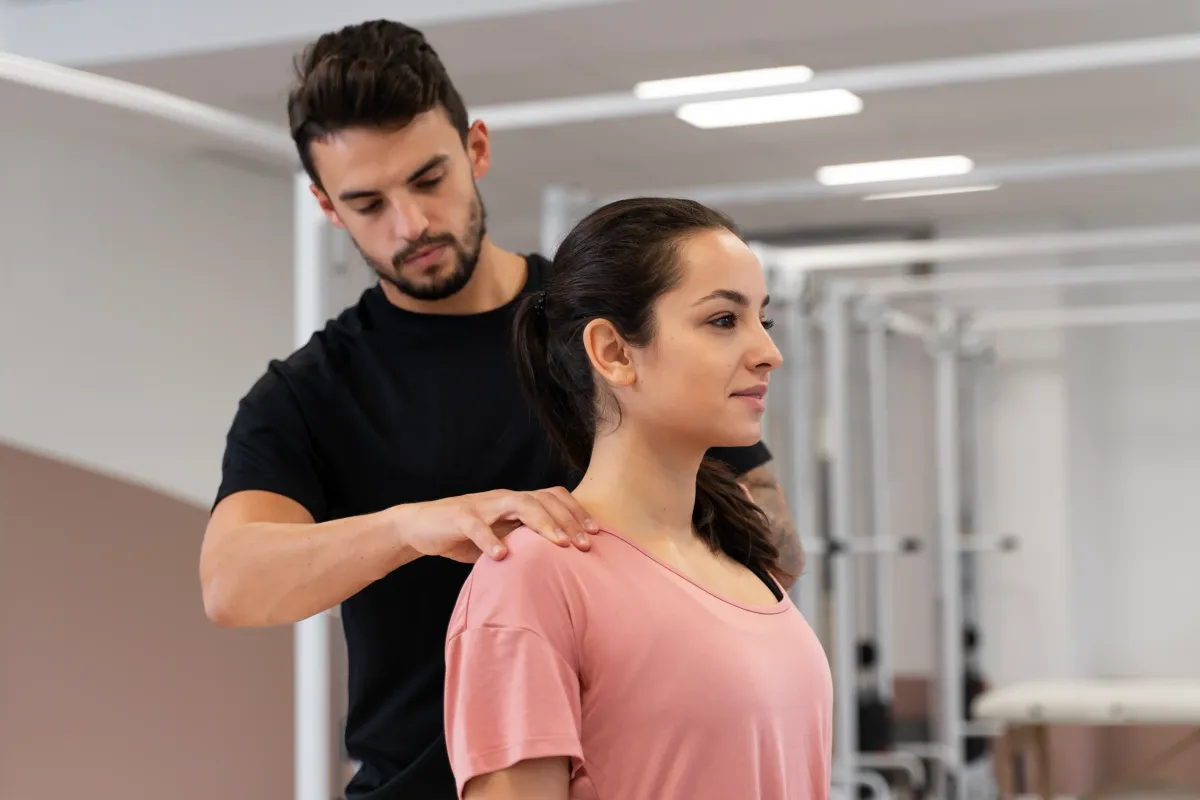
A physical therapist begins with a comprehensive evaluation that examines your posture, shoulder blade position, spinal mobility, muscle flexibility, strength, movement patterns, and daily activities to identify the factors contributing to your condition. Your treatment plan may include:
Manual therapy to reduce muscle tightness and improve mobility
Stretching tight chest, neck, and shoulder muscles
Strengthening the muscles that stabilize the shoulder blades
Postural retraining during work, driving, lifting, and daily activities
Ergonomic recommendations for your workstation or home setup
Progressive exercises designed to restore normal movement patterns
Rather than focusing only on the shoulders, physical therapy addresses the entire kinetic chain, including the neck, upper back, thoracic spine, and core. Treating these connected areas improves long-term posture and reduces the likelihood of symptoms returning.
Exercises for Rounded Shoulders
Exercise is one of the most effective ways to improve rounded shoulders, but only when it targets the right muscles. The goal isn't simply to "pull your shoulders back." Instead, treatment focuses on stretching muscles that have become tight while strengthening those that have become weak.
The following exercises are commonly recommended by physical therapists and are also supported by Healthline for improving posture and correcting muscle imbalances associated with rounded shoulders.
Doorway Chest Stretch
Tight chest muscles are one of the biggest contributors to rounded shoulders. The doorway stretch helps lengthen the pectoral muscles, allowing the shoulders to return to a more natural position.
How to perform:
Stand in a doorway with your elbows bent to 90 degrees.
Place your forearms against each side of the frame.
Step forward slowly until you feel a gentle stretch across your chest.
Hold for 15 to 30 seconds.
Repeat 3 times, two to three times daily.
Chin Tucks
Forward head posture commonly accompanies rounded shoulders. Chin tucks strengthen the deep neck flexor muscles while improving cervical alignment.
How to perform:
Sit or lie comfortably.
Keep your eyes facing forward.
Gently pull your chin backward, creating a "double chin."
Hold for 5 to 10 seconds.
Repeat 10 to 15 repetitions.
Band Pull-Aparts
This exercise strengthens the muscles between your shoulder blades, helping improve posture throughout the day.
How to perform:
Hold a resistance band with both arms extended.
Pull the band apart while squeezing your shoulder blades together.
Slowly return to the starting position.
Perform 2 sets of 10 to 12 repetitions.
Scapular Wall Slides
Wall slides improve shoulder blade control, mobility, and stability while encouraging proper posture.
How to perform:
Stand with your back against a wall.
Bend your elbows to 90 degrees.
Slowly slide your arms overhead while maintaining contact with the wall.
Return slowly.
Perform 2 sets of 10 repetitions.
Prone I, T, and Y Raises
These exercises strengthen the smaller stabilizing muscles responsible for maintaining proper shoulder blade positioning.
They are particularly useful for improving endurance of the middle and lower trapezius and other postural muscles that weaken with prolonged sitting.
Important: Exercises should never significantly increase pain. If your symptoms worsen or persist, stop the exercise and consult a licensed physical therapist for an individualized treatment plan.
Tips to Prevent Rounded Shoulders
Although physical therapy is highly effective, preventing poor posture from returning requires healthy daily habits. Simple changes can make a significant difference:
Position your computer monitor at eye level.
Avoid looking down at your phone for prolonged periods.
Take movement breaks every 30 to 60 minutes during desk work.
Sit with your shoulders relaxed rather than slouched.
Adjust your workstation to promote good ergonomics.
Strengthen your upper back and core regularly.
Stretch your chest muscles throughout the day.
Sleep in a position that keeps your neck and shoulders aligned.
When Should You See a Physical Therapist?
Occasional stiffness after a long day at work is common. However, persistent rounded shoulders accompanied by pain or limited movement should not be ignored. Consider scheduling an evaluation if you experience:
Frequent upper back or shoulder pain
Reduced shoulder mobility
Pain while lifting your arms
Recurrent tension headaches
Numbness or tingling into the arm
Difficulty maintaining good posture despite exercise
Don't let poor posture lead to chronic neck, shoulder, or upper back pain. Our experienced physical therapists provide personalized treatment plans to help you move better and feel better. Call (973) 241-1338 today to schedule your evaluation and take the first step toward better posture and lasting relief.
Clifton Physical Therapy
✆ Phone (appointments): (973)-241-1338
Address: 1059 Bloomfield Ave, Clifton, NJ 07012


