Acupuncture for Sciatica Pain in Clifton, NJ
Reviewed by John Miller, LAc, Licensed Acupuncturist
Quick answer: Acupuncture can ease sciatica pain for some people, especially alongside exercise and hands-on care. In a 2024 trial of 216 adults with disc-related sciatica, real acupuncture reduced leg pain and improved physical function more than sham needling, and the benefit lasted up to a year. It isn’t a cure, and it isn’t right for everyone.
Who Is Behind This Advice?
John Miller, LAc, is a licensed acupuncturist in Clifton, New Jersey, with specialized training in orthopedic acupuncture and trigger point therapy. He earned his Master of Acupuncture and Oriental Medicine from the New England School of Acupuncture and has studied Tong Ren healing with Tom Tam since 2006. His clinical focus includes nerve-related pain, back pain, and sports injuries, providing relevant experience in addressing sciatica symptoms.
What Sciatica Actually Feels Like
Most people don’t call it “sciatica” at first. They say, “My leg has been acting up.”
It starts as an ache in the glute. Then a burning or tingling line runs down the back of the thigh. Maybe your foot goes a little numb. Sitting through a meeting, a drive down Route 3, or a long shift on your feet turns into something you plan around.
Sciatica is pain that follows the sciatic nerve, which runs from the low back through the buttock and down the leg. It usually hits one side. The most common cause is a herniated or bulging disc pressing on a nerve root. Other causes include spinal narrowing (stenosis) and a tight piriformis muscle in the buttock.
The cause matters, because “leg pain” isn’t one problem. A disc irritating a nerve root behaves differently from a muscle squeezing the nerve in the hip. A good clinician sorts that out before picking a treatment.
See a doctor right away if you have new bladder or bowel changes, numbness in the groin or inner thighs, leg weakness that keeps getting worse, fever, or pain that is escalating fast. Those are not “try acupuncture first” situations.
Why the Pain Sticks Around
Here is the part that surprises many patients. The original nerve irritation is often only half the story.
When a nerve is sensitive, your body protects it by tightening the muscles around it: the low back, the glutes, the deep hip rotators, the hamstrings. That guarding is a reasonable reflex, but it adds pressure to an area that is already irritated. More irritation leads to more guarding, and the cycle feeds itself.
That is why rest alone often disappoints. A week on the couch can calm a flare-up, but it can also leave the hip stiffer than before. And over-the-counter anti-inflammatories only go so far. Many people tell us the pills “take the edge off” and nothing more.
Most first-line care for sciatica is simple and works for a lot of people: staying active within your tolerance, gentle stretching, physical therapy, and short-term pain medication. Acupuncture usually comes in when those steps haven’t done enough, or when pain is high enough that you can’t tolerate the exercise you need.
What the Research Says (and Where It Falls Short)
Acupuncture has real evidence behind it for sciatica, but the evidence is uneven. Here is what the better studies show.
The strongest recent study
A randomized trial in JAMA Internal Medicine (December 2024) enrolled 216 adults, average age 51, with sciatica from a herniated disc. Half received real acupuncture and half received a sham procedure, 10 sessions over four weeks. The real-acupuncture group reported less leg pain and better physical function, and the difference was still there at one year. The sham comparison matters because it helps separate the needle effect from the placebo effect, which is strong in pain research.
The wider picture
A systematic review of 11 randomized trials found acupuncture may work better than medication alone and may boost the effect of medication. The authors were frank that the studies were too few and too uneven in quality to be certain. Some older reports claim success rates near 90%. Those numbers come from small studies that often compared acupuncture with a drug rather than with sham treatment, so we treat them with caution.
What the research does not show.
No study shows acupuncture repairs a herniated disc or permanently resolves sciatica on its own. Some practitioners claim it does. We think that overpromises. What the evidence supports is pain relief and better function, which can give you room to move, strengthen, and heal.
How Acupuncture May Help Sciatica Pain
Researchers don’t agree on one explanation, and it’s worth saying so. These are the mechanisms with the most support:
Pain signaling
Needling appears to trigger the release of endorphins and other natural pain-regulating chemicals, which can turn down how intensely the nervous system reacts to input from the irritated nerve.
Muscle guarding
Needles placed in the glute, hip, and low back can help release the protective tightness around the nerve, including trigger points in the piriformis and deep hip muscles.
Local circulation
Needling seems to increase blood flow in tight, compressed tissue, which may reduce stiffness and make movement feel easier.
What a Session Looks Like
A first visit should start with questions, not needles. Expect to talk about where the pain travels, what makes it worse, how long you can sit or walk, and how you’re sleeping. A hands-on screen of your hip and spine movement helps pinpoint whether a disc, a tight muscle, or both are involved. That assessment decides where the needles go.
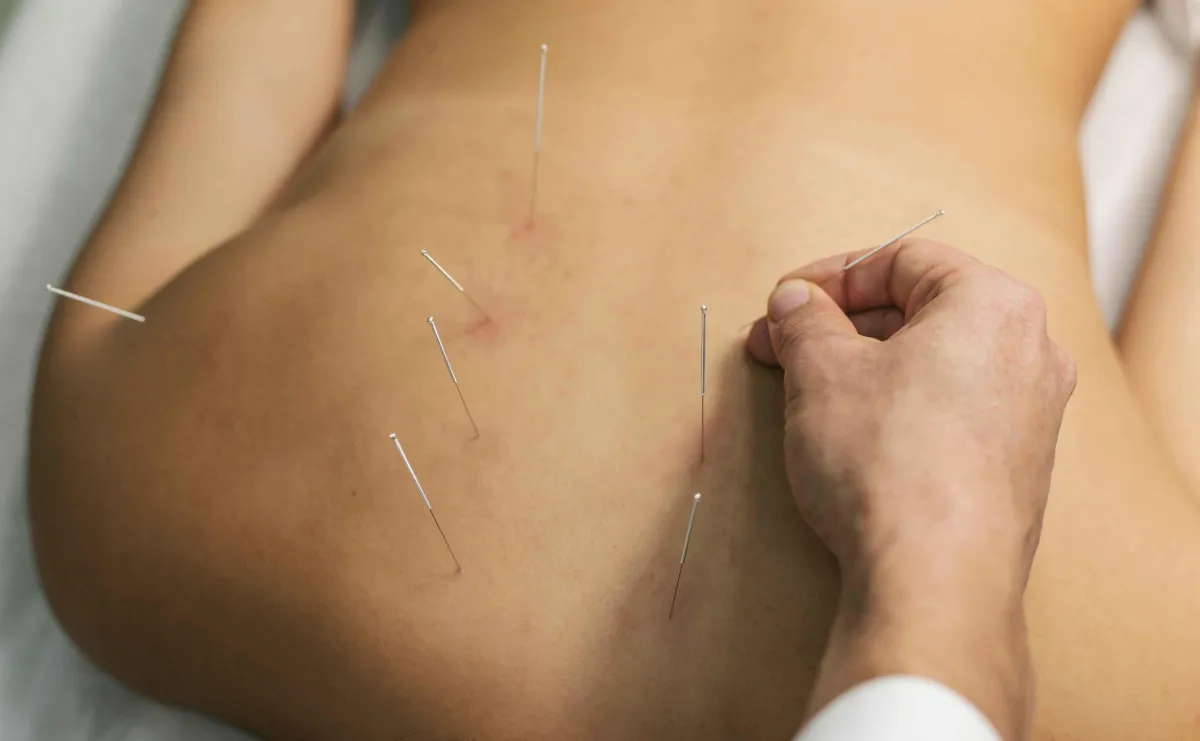
Points are usually chosen in the low back, buttock, and along the back of the leg. Some practitioners also use points in the lower leg, ankle, or even the forearm, based on a distal-needling approach. Most people feel a dull ache, warmth, heaviness, or a small muscle twitch as the needle settles, not sharp pain. Tell your practitioner right away if anything feels too intense. Sessions typically run 20 to 60 minutes.
What to Do Between Sessions
Needling opens a window. What you do with it matters.
Walk daily, even 10 minutes, as long as symptoms stay tolerable.
Break up long stretches of sitting every 30 minutes.
Do the gentle hip and hamstring work your therapist gives you.
Track your pain and sitting tolerance after each visit, so you can tell if it’s working.
Is It Safe, and Who Should Try It?
Acupuncture has a good safety record when a licensed practitioner uses sterile, single-use needles. Common side effects are minor: slight soreness, a small bruise, or feeling tired afterward. Serious problems are rare.
Tell your practitioner first if you take blood thinners, have a bleeding disorder, are pregnant, or have a pacemaker (electroacupuncture needs extra care there).
It tends to suit people who have had sciatica for a few weeks to a few months, whose pain is limiting sitting, walking, or sleep, and who haven’t gotten enough from stretching or medication.
How Many Visits Do I need?
The 2024 trial used 10 sessions over four weeks, so that’s a reasonable benchmark. Some people feel a change within three or four visits. Others get only modest, short-lived relief. If you’ve had little change after a handful of sessions, that’s useful information. It’s a sign to adjust the plan, not to keep repeating it.
Sciatica doesn’t have to run your day. Call us at (973) 241-1338 to book an assessment, and we’ll help you find the cause and the right next step.
Frequently Asked Questions
Question 1: Is acupuncture effective for sciatica pain?
Yes. Acupuncture has been shown to reduce inflammation, relax tight muscles, and relieve pressure on the sciatic nerve. Many patients experience significant pain relief and improved mobility after treatment.
Question 2: How many acupuncture sessions are needed for sciatica?
The number of sessions depends on the severity and duration of your symptoms. Some patients feel relief after one or two visits, while others may need several weeks of consistent treatment for lasting results.
Question 3: Does acupuncture for sciatica hurt?
No. Acupuncture uses very fine, sterile needles that cause little to no pain when inserted. Most patients describe the sensation as mild tingling or warmth, and many feel deeply relaxed during treatment.
Question 4: Can acupuncture be combined with other treatments?
Absolutely. Acupuncture works well alongside physical therapy, massage, and lifestyle changes. This combined approach not only relieves pain but also strengthens the body to prevent future flare-ups.
Question 5: Is acupuncture safe for everyone with sciatica?
Acupuncture is generally safe when performed by a licensed professional. However, patients with certain conditions (such as bleeding disorders or those on blood thinners) should consult their healthcare provider before starting treatment.

What patients are saying
"I recently had ankle surgery and Clifton PT has been nothing short of amazing! My goal was to get back to playing soccer as quick as possible before the college season started and so far I'm right on track. Izzy, Bianca, Tiff, and John have gone above and beyond to make sure I'm back to 100%. Couldn't be more grateful to be treated by the best team ever!." - Nat Rufino

All the therapists at Clifton Physical Therapy are awesome, but I spend most of my time with Izzy and Bianca—and they’ve been amazing. They’re enthusiastic, knowledgeable, and always take the time to explain what I’m doing and what my issues are. Their positive energy and clear communication make a big difference in my recovery." - Bryan Tompkins
"Going Clifton physical therapy was one of the best thing that came out of my back pain! Every single staff member is amazing and cares for your recovery! I have been with them for the past couple of months and now continuing their workout program! I can’t recommend them enough! Tiffany, Izzy, Bianca and everyone else I have worked with there! Can’t rave about them enough!!." - Monica Mehta
"Clifton Physical Therapy has been a great place for me to heal my meniscus tear. The staff is very knowledgeable and friendly, and has been extremely helpful in guiding me through my recovery. I highly recommend their services.." - Kelly Bevando
Clifton Physical Therapy
✆ Phone (appointments): (973)-241-1338
Address: 1059 Bloomfield Ave, Clifton, NJ 07012
Clifton Physical Therapy | cliftonphysio.com


