Non-Invasive Skin Tightening in NJ
Clifton Physical Therapy
What "Non-Invasive Skin Tightening" Actually Means
Loose skin, fine lines, and that "tired" look in the mirror usually come down to one thing: collagen. Your body makes less of it every year after your mid-20s, and by your 40s and 50s, the drop-off is noticeable — especially around the cheeks, nasolabial folds, and jawline. The good news is that you don't need surgery or a long recovery to do something about it.
At Clifton Physical Therapy, patients across Passaic County ask us the same question almost every week: is there a way to firm up skin without going under the knife? For most people, the answer is yes, and it usually comes down to two well-studied, non-surgical options — light-based therapy and collagen-stimulating treatment (also called microneedling). Both work by encouraging your own skin to rebuild collagen rather than masking the problem with fillers or cutting it away with surgery.
Light-Based Therapy
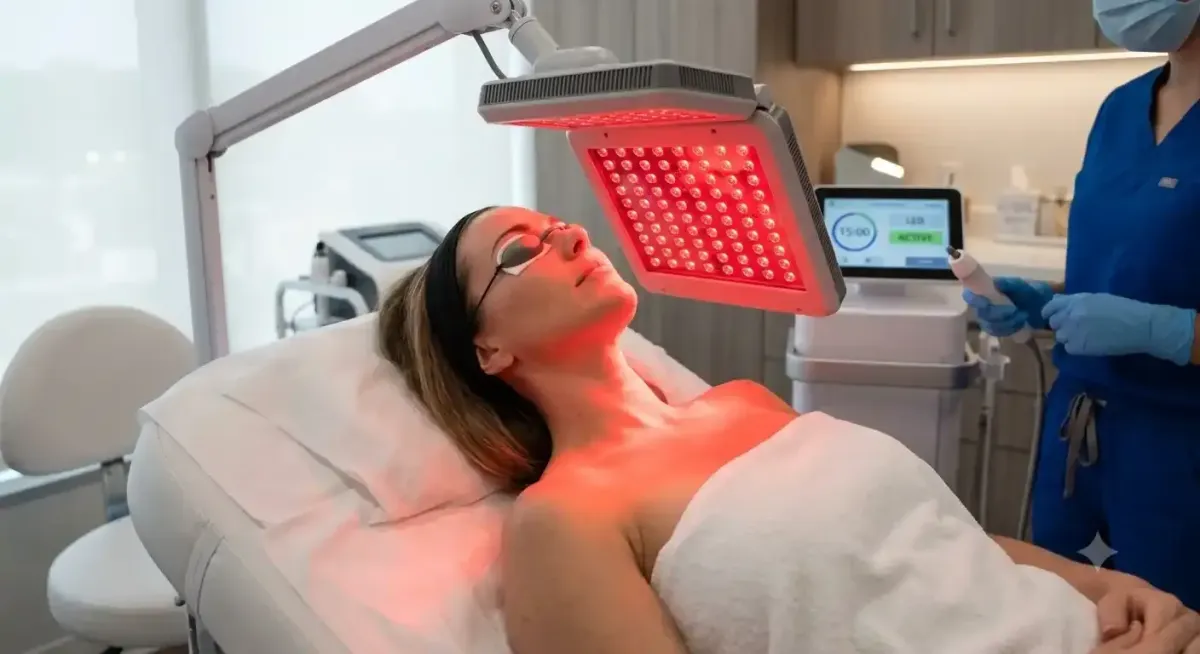
Light-based therapy, often called red light therapy or LED photobiomodulation, uses specific wavelengths of light to reach the deeper layers of your skin. Unlike tanning beds or the sun, it doesn't use UV light, so there's no burning and no increased skin cancer risk associated with the treatment itself.
Here's the mechanism in plain terms: red and near-infrared wavelengths penetrate deeper than blue light and get absorbed by the mitochondria in your skin cells — the part of the cell responsible for energy production. That extra energy appears to signal cells to repair themselves and ramp up collagen production, which is what gradually tightens and smooths the skin over a series of sessions.
Clinical research has shown promising results for light-based skin rejuvenation. According to a randomized controlled study available through the National Library of Medicine (PubMed), 136 volunteers who underwent regular red and near-infrared light treatments experienced improvements in skin complexion, smoother skin texture, and increased collagen density compared with the control group. Independent reviewers also confirmed visible improvements in clinical photographs, supporting the benefits of consistent light therapy over multiple sessions.
A typical in-office session runs about 20 minutes. You'll wear protective goggles while a panel of LEDs sits above your face — there's no discomfort beyond a mild, pleasant warmth. Most patients need weekly sessions for around a month to notice a real difference, followed by maintenance visits every few weeks. Because it's non-ablative (it doesn't break the skin's surface), there's no downtime — you can go back to your normal day, though we do recommend staying out of direct sun and using sunscreen for a few days afterward.
Light therapy tends to work best for patients dealing with early fine lines, mild sun damage, uneven tone, or redness who want a gentle, cumulative approach with zero recovery time.
It's worth being clear about what light-based therapy doesn't do. It won't treat acne cysts, blackheads, or whiteheads, and it isn't a substitute for surgery on significantly sagging skin. It's also not appropriate for everyone — people taking photosensitizing medications like isotretinoin or lithium, or those with a personal history of skin cancer or certain inherited eye conditions, should discuss alternatives with their provider first. Side effects are uncommon and typically mild when they do occur, limited to temporary redness, irritation, or increased sensitivity in the treated area.
Collagen-Stimulating Therapy (Microneedling)
Collagen-stimulating therapy — most commonly known as microneedling or dermal needling — takes a more direct approach. Instead of using light to nudge your cells into action, a trained practitioner uses a device with fine, sterile needles to create controlled micro-injuries at the junction between the epidermis and dermis. Your body reads this as an injury and floods the area with new collagen and elastin to heal it, which is exactly the response we're after.
First introduced clinically in 1997 as a gentler alternative to aggressive lasers and chemical peels, microneedling has become one of the most researched options for treating wrinkles, acne scarring, stretch marks, and sun damage. Because the treatment stimulates ongoing collagen turnover rather than a one-time reaction, results tend to keep improving for several weeks after treatment and can remain visible for up to two years.
A full session generally takes 60 to 90 minutes. Your provider numbs the skin first, then works the needling device across the treatment area. You'll likely see small pinpoint spots where the needles penetrated — this is normal and a sign the collagen response has been triggered. Afterward, we clean the skin, apply a calming mask to reduce redness, and finish with targeted vitamin A and peptide products to support healing.
Downtime is short compared to more aggressive resurfacing procedures. Expect redness for a day or so, with some patients comfortable applying makeup the next day. Mild flaking is common for four to five days as the skin renews itself. Full results can take anywhere from about a week to several months to fully develop, and most treatment plans involve up to four sessions spaced three to four weeks apart.
Because it does involve breaking the skin's surface, microneedling isn't the right fit for everyone. Patients with active acne, unstable skin conditions, keloid scarring, or an active skin infection should hold off and talk with their provider about alternatives first. Minor bleeding or pinpoint bruising can happen with deeper treatments, and anyone on blood-thinning medication should mention that during their consultation so the provider can adjust the approach accordingly.
One detail patients often don't expect: unlike a facial, this is a medical-grade procedure that should only be performed by a trained practitioner, not a spa aesthetician working outside a clinical setting. The depth of the needles, the sterilization protocol, and the post-treatment products all affect both the results and the safety of the procedure, which is why we treat it as a clinical service rather than a spa add-on.
Which Areas Can Be Treated?
Both treatments are versatile, but they're not limited to just the face. Common areas we treat include:
Face
Under-eye area
Hands
Body areas prone to scarring or stretch marks
Which Treatment Is Right for You?
There's no universal winner between these two — the right choice depends on your skin, your goals, and how much downtime you're willing to work around.
If you want a gentle, no-downtime option you can fit around a busy Clifton or greater NJ schedule — think lunchtime appointments before heading back to work — light-based therapy is usually the more comfortable starting point. It's especially well suited to early signs of aging, mild redness, and general skin maintenance, and it layers nicely alongside other treatments like microneedling or a medical-grade skincare routine.
If your main concern is more pronounced wrinkles, deeper folds, acne scarring, or loose skin that hasn't responded to gentler options, collagen-stimulating therapy tends to deliver more noticeable, longer-lasting change — you're just trading a few days of mild redness and flaking for results that can last up to two years.
Many of our patients actually do both: microneedling for the deeper structural rebuild, and red light sessions in between visits to support healing and keep collagen production active. As with any skin treatment, results vary from person to person, and certain medications, skin conditions, or a history of skin cancer can rule out one option or the other.
The safest way to find out what will actually work for your skin is a real conversation with a provider who can look at your skin in person, review your history, and build a plan around your goals — not a generic package. If you're in the Clifton area and curious whether light-based therapy, collagen-stimulating treatment, or a combination of both makes sense for you, our team can walk you through what to expect before you commit to anything.
Ready to talk to someone about your skin? Call Clifton Physical Therapy at (973) 241-1338 to schedule a consultation, or stop by our Bloomfield Ave office to ask questions in person.
What patients are saying
"I recently had ankle surgery and Clifton PT has been nothing short of amazing! My goal was to get back to playing soccer as quick as possible before the college season started and so far I'm right on track. Izzy, Bianca, Tiff, and John have gone above and beyond to make sure I'm back to 100%. Couldn't be more grateful to be treated by the best team ever!." - Nat Rufino

All the therapists at Clifton Physical Therapy are awesome, but I spend most of my time with Izzy and Bianca—and they’ve been amazing. They’re enthusiastic, knowledgeable, and always take the time to explain what I’m doing and what my issues are. Their positive energy and clear communication make a big difference in my recovery." - Bryan Tompkins
"Going Clifton physical therapy was one of the best thing that came out of my back pain! Every single staff member is amazing and cares for your recovery! I have been with them for the past couple of months and now continuing their workout program! I can’t recommend them enough! Tiffany, Izzy, Bianca and everyone else I have worked with there! Can’t rave about them enough!!." - Monica Mehta
"Clifton Physical Therapy has been a great place for me to heal my meniscus tear. The staff is very knowledgeable and friendly, and has been extremely helpful in guiding me through my recovery. I highly recommend their services.." - Kelly Bevando
Clifton Physical Therapy
✆ Phone (appointments): (973)-241-1338
Address: 1059 Bloomfield Ave, Clifton, NJ 07012
Clifton Physical Therapy | cliftonphysio.com


